AWS Certified AI Practitioner (AIF-C01)
AWS Certified AI Practitioner (AIF-C01) certification study notes, this guide will help you with quick revision before the exam. it can use as study notes for your preparation.
DashboardGenAI Introduction
- GenAI Introduction
What is Generative AI?
- Generative AI is a branch of Deep Learning
- The idea is simple: you train a model on existing data, and it learns to create new data that looks similar
- Think of it like teaching someone to paint by showing them thousands of paintings
- Once trained, it can create brand new content that follows the same patterns
How it differs from traditional AI
- Traditional AI: Analyzes and classifies existing data (“Is this a cat or dog?”)
- Generative AI: Creates new data (“Generate a picture of a cat playing piano”)
- It’s like the difference between sorting mail and writing letters
Real-world applications
- Chatbots: Having conversations (ChatGPT, Claude)
- Code generation: Writing code from descriptions (GitHub Copilot)
- Image creation: Making art and photos (DALL-E, Midjourney)
- Music composition: Creating original music
- Content writing: Blogs, emails, marketing copy
- Video generation: Creating video clips from text
Why it’s revolutionary
- Can automate creative tasks that humans do
- Works across multiple types of content (text, images, audio, video)
- Gets better over time as models improve
- Makes advanced AI accessible to everyone through simple prompts
-
Can combine ideas in ways humans might not think of
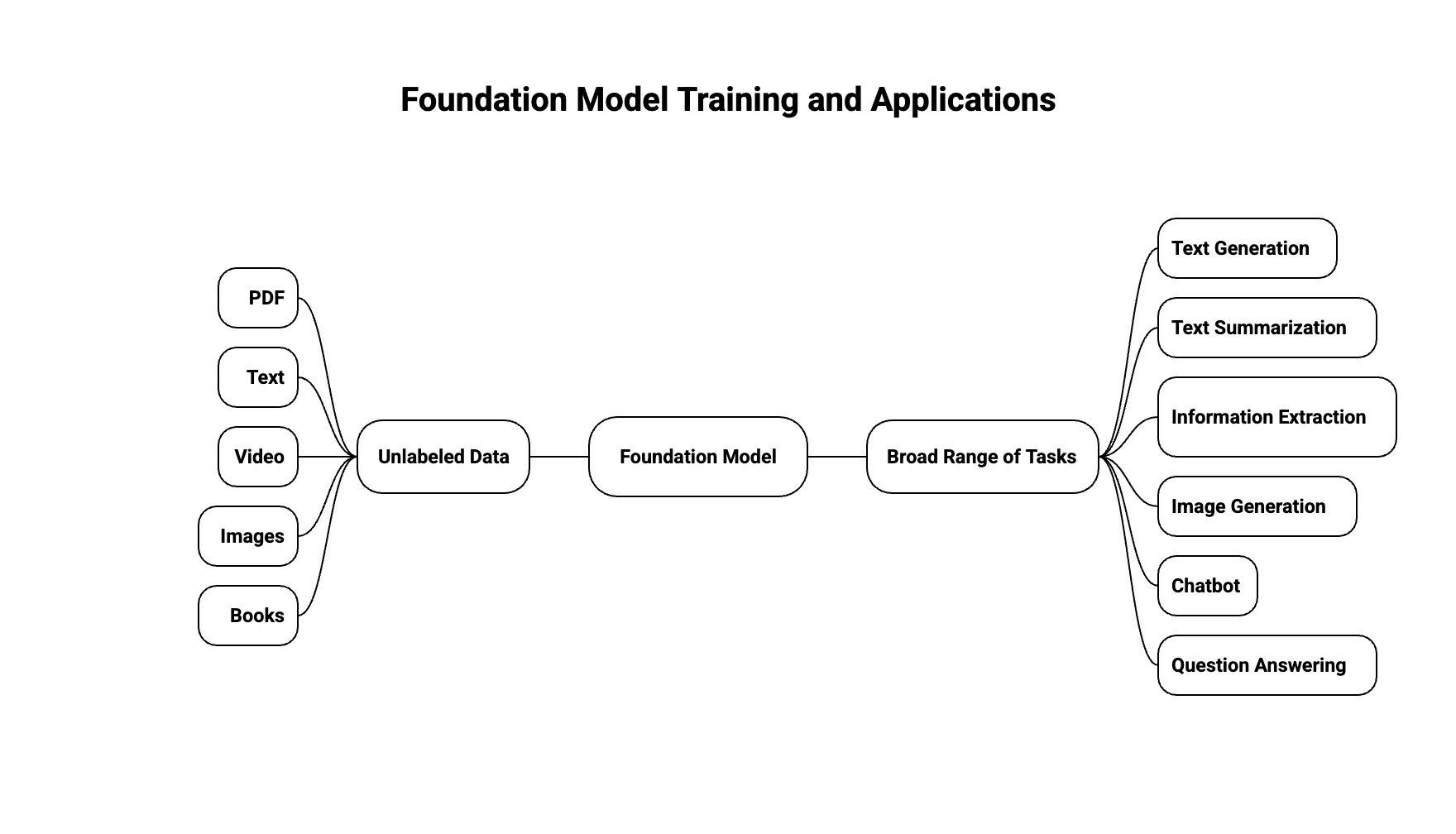
- You can train these models on almost anything:
- Text: Books, articles, conversations
- Images: Photos, paintings, illustrations
- Audio: Music, speech, sound effects
- Code: Programming languages and scripts
- Video: Movies, TV shows, clips
- And more: 3D models, scientific data, etc.
Foundation Model
- To create anything, you need a Foundation Model
- These models are trained on huge amounts of data from different sources
- Training one is expensive - think tens of millions of dollars
- Examples: GPT-4o is the foundation model that powers ChatGPT
- You can find foundation models from big companies like:
- OpenAI
- Meta (Facebook)
- Amazon
- Anthropic
- And many others
- Some are free and open (like Meta’s Llama, Google’s BERT), while others cost money to use (like OpenAI’s GPT-4o)
Large Language Models
- These are AI models that generate text that sounds like a human wrote it (like ChatGPT)
- They learn from massive amounts of text - books, articles, websites, basically everything
- They’re huge models with billions of parameters
What makes them “large”
- GPT-3 has 175 billion parameters
- GPT-4 has even more (exact number is not publicly disclosed)
- Parameters are like the knobs that the model adjusts during training
- More parameters usually means better understanding and more capabilities
-
But also means more computing power and cost to run
- They can do all sorts of language tasks:
- Translation: Convert text from one language to another
- Summarization: Condense long articles into short summaries
- Answering questions: Respond to questions based on their training
- Creating content: Write stories, emails, code, etc.
- Classification: Categorize text into different groups
- Named entity recognition: Identify people, places, organizations in text
How to use them
- You give them a prompt (instructions or questions)
- They use everything they’ve learned to create new content
- The better your prompt, the better the output
- You can guide them with examples, instructions, or conversation
Important characteristics
- Unpredictable: Same prompt might give different results each time
- Context window: Limited by how much text they can “remember” at once
- Knowledge cutoff: Only know information up to their training date
- Can hallucinate: Make up facts that sound believable but aren’t true
- No real understanding: They don’t truly understand meaning, just patterns
Popular LLM examples
- GPT-4 (OpenAI) - Powers ChatGPT
- Claude (Anthropic) - Known for being helpful and safe
- Gemini (Google) - Multi modal (can handle text, images, audio)
- Llama (Meta) - Open source, can run on your own hardware
- PaLM (Google) - Very large, used in various Google products
Generative Language Models
- These are models specifically designed to generate text that makes sense
- They predict what word comes next based on what came before (like autocomplete on steroids)
The way they work
- They break down text into smaller pieces called tokens
- Each token gets turned into numbers (embeddings) that the model can understand
- The model looks at all previous tokens and guesses the next one
- It builds responses word by word, considering the whole context
Example of next-word prediction
- Given: “After the storm passed, the village was”
- The model calculates probabilities for the next word:
- “destroyed” (25% probability)
- “flooded” (18% probability)
- “quiet” (15% probability)
- “empty” (12% probability)
- “rebuilt” (8% probability)
- … and many other options
- The model randomly selects from these probabilities, so different runs might give different results
- Each choice affects the next word prediction, building a coherent story
Key characteristics
- Context-aware: They remember what you said earlier in the conversation
- Probabilistic: They don’t always pick the “best” word, they pick from likely options
- This is why you get different outputs for the same input
How they’re trained
- Pre-training: Learn general language patterns from tons of text data
- Fine-tuning: Adjust the model for specific tasks (like following instructions)
- This two-step process makes them both knowledgeable and helpful
The power of generative models
- They can keep conversations going naturally
- They adapt their style based on your prompt
- They can be creative when asked (write stories, poems, code)
GenAI for Images
- Just like LLMs generate text, some models can generate images from text descriptions
- One popular type is called Diffusion Models (like Stable Diffusion from Stability AI)
- They basically learn what images look like and can create new ones based on your description
How diffusion models work
- Start with random noise (like static on a TV)
- Gradually remove noise step by step
- Guide the process with your text prompt
- End up with a clear, meaningful image
What they can do
- Text-to-image: Turn descriptions into images (“a red sunset over mountains”)
- Image-to-image: Modify existing images based on text (“make this photo look like a painting”)
- Inpainting: Fill in missing parts of images
-
Style transfer: Apply artistic styles to photos
- Popular models and tools:
- Stable Diffusion (open source, can run on your computer)
- DALL-E (from OpenAI, used in ChatGPT)
- Midjourney (very artistic, high-quality results)
- Key differences from LLMs:
- Images are 2D grids of pixels (not sequential like text)
- Need to learn patterns like colors, shapes, textures, lighting
- Much larger files (images vs text)
- More computational power needed
- Usually slower to generate than text
- Common use cases:
- Creating art and illustrations
- Generating product mockups
- Architectural visualization
- Creating marketing visuals
- Personalized avatars and portraits
- Concept art for games and movies